How to Verify Property Documents in Pakistan
Before you pay a single rupee, you need to know that the person selling the property actually owns it — and that the papers are genuine. This guide explains which documents to check, where to verify them, and the red flags that should stop a deal.
Why Document Verification Is the Most Important Step
In Pakistan, most property disputes do not come from bad construction or a bad location. They come from bad paperwork — an unclear title, a missing mutation entry, a forged stamp, or a property that was already sold or mortgaged.
Once money has changed hands, reversing a transaction is slow, costly and sometimes impossible. Verification is the step that protects you before that happens.
This guide covers the documents you must check, the offices that hold the records, and the practical steps to confirm that a seller really has the right to sell the property.
- Ownership Check
- Title Chain
- Mutation Record
- Dues & Charges
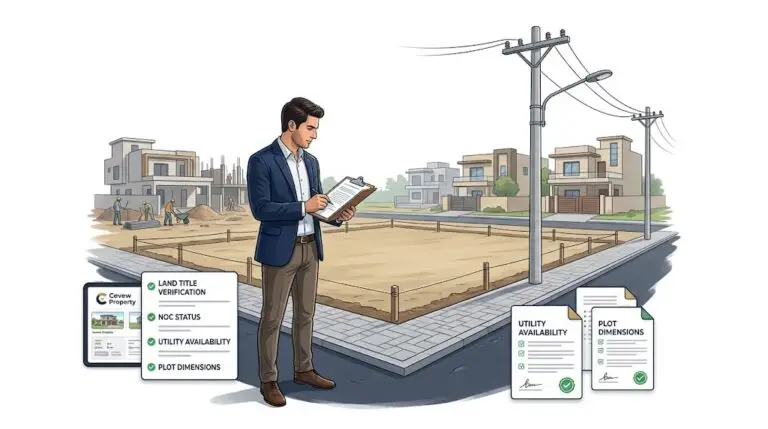
- Approval & NOC
- Encumbrance Check

Documents You Must Verify Before Buying
Six categories of paperwork carry almost all the risk in a Pakistani property transaction. Each one should be checked at source — not just viewed as a photocopy.
Title Deed / Registry
Ownership ProofThe registered sale deed is the primary proof of ownership. Confirm the seller's name appears as owner and that the deed is registered — not just signed on stamp paper.
- Seller's name matches CNIC
- Registered, not only notarised
- Correct plot and area details
- Signatures and witnesses intact
Fard / Mutation (Intiqal)
Revenue RecordThe Fard Malkiat shows current ownership in the revenue record, and the mutation entry shows how ownership transferred. Both should match the deed and the seller's claim.
- Current owner name
- Mutation number and date
- Khasra / Khewat details
- Obtained from the tehsil office
No-Encumbrance Certificate
Clear TitleConfirms whether the property is mortgaged, pledged or tied to any bank loan. A property with an active mortgage cannot be freely transferred until it is cleared.
- No active bank mortgage
- No court attachment
- No pending lien
- Issued by the relevant authority
Approved Building Plan
ConstructionFor a constructed house, the approved plan confirms the building was sanctioned by the relevant development or municipal authority and matches what is actually on the ground.
- Sanctioned by the authority
- Matches actual construction
- Setbacks and floors compliant
- Completion certificate where required
Dues & Utility Clearance
Outstanding ChargesUnpaid development charges, society dues, property tax, gas and electricity bills can become the buyer's problem if they are not settled before transfer.
- Society / development dues cleared
- Property tax paid to date
- Gas and electricity bills clear
- Written clearance from the seller
NOC / Authority Approval
RegulatoryFor properties inside housing schemes and developments, an NOC confirms the transfer is permitted and the plot is not under any dispute with the developer.
- NOC issued by the society
- Transfer permitted in writing
- No dispute with the developer
- Membership record updated
Offices and Authorities That Hold the Records
Documents should be confirmed at the source. These are the main offices involved in a typical Pakistani property verification.
Sub-Registrar Office
Holds registered sale deeds, transfer records and stamp duty records for the property.
Ask for GuidanceTehsil / Patwari Office
Maintains the Fard Malkiat, mutation entries and revenue maps for land records.
Ask for GuidanceDevelopment Authority
CDA, TMA or the relevant housing authority approves plans and issues NOCs and completion certificates.
Ask for GuidanceHousing Society Office
Confirms membership, transfer permission, NOC and clearance of society dues for the plot.
Ask for GuidanceWhat to Check, Where, and Why
A practical reference table you can use during verification. Confirm each item at source rather than relying on photocopies.
| Document | What It Confirms | Where to Verify | Ask |
|---|---|---|---|
| Sale Deed / Registry Ownership | That the seller is the registered owner and the transfer was legally recorded. | Sub-Registrar office where the deed was registered. | |
| Fard Malkiat Revenue Record | The owner's name in the government revenue record and the plot details. | Tehsil office or the relevant revenue authority. | |
| Mutation / Intiqal Transfer History | How and when ownership passed to the current seller, and the chain before that. | Tehsil office records and the mutation register. | |
| No-Encumbrance Clear Title | That the property is not mortgaged, attached or tied to an active loan. | Relevant authority, bank or court record check. | |
| Approved Plan Construction | That the building was sanctioned and matches the approved drawings. | CDA, TMA or the relevant development authority. | |
| NOC Permission | That the society or authority permits the transfer and there is no dispute. | Housing society or development authority office. | |
| Dues Clearance Financial | That development charges, property tax and utility bills are fully settled. | Society office, tax authority and utility providers. | |
| CNIC & Identity Parties | That the seller and witnesses are who they claim to be. | NADRA verification and in-person matching. |
Want Your Documents Checked Before You Commit?
Send the basic details of the property and the seller's documents. You will get clear guidance on what still needs to be verified — and what looks out of order.
Share the Property Details
Location, plot number, size and the scheme or sector it falls under.
Send DetailsSend the Documents
Share clear photos of the deed, Fard, mutation entry and any NOC available.
Send DocumentsConfirm Your Timeline
Tell us when you plan to pay the token or final amount, so checks are done in time.
Discuss TimelineRed Flags That Should Stop the Deal
If any of these appear, pause the transaction and get the paperwork independently checked before paying anything.
Seller Avoids the Registry
If the seller insists on a "simple" transfer on stamp paper or refuses to go to the sub-registrar, treat it as a serious warning.
Name Mismatch on Documents
If the name on the deed, the CNIC and the revenue record do not match, stop until the discrepancy is explained and corrected.
Pressure to Pay Quickly
Urgency is a common tactic used to prevent buyers from doing proper verification. A genuine seller will not object to a few days of checks.
Photocopies Only
If you are only ever shown photocopies and never originals, or the seller cannot produce the Fard, that is a major concern.
Unpaid Dues "To Be Sorted Later"
Any promise that dues will be cleared after the sale usually means they become the buyer's responsibility. Insist on written clearance.
Seller Is Not the Owner
A relative, agent or "authorised representative" selling on behalf of someone else needs a properly executed power of attorney — verified.
How to Verify Property Documents
A practical four-step process you can follow for any property in Pakistan.
Get the Originals
Ask the seller for original documents and clear copies of their CNIC and photograph.
Match Names and Details
Cross-check the name, plot number, size and location across every document.
Verify at Source
Confirm the deed at the sub-registrar and the Fard and mutation at the tehsil office.
Confirm Clearance
Check dues, NOC and no-encumbrance before paying the token or final amount.
Final Pre-Payment Checklist
- Original sale deed inspected and matched to the seller's CNIC.
- Fard Malkiat obtained from the tehsil office showing the seller as owner.
- Mutation entry confirmed and the transfer chain reviewed.
- No-encumbrance status confirmed — no mortgage, lien or court attachment.
- Approved building plan verified for a constructed house.
- NOC from the society or authority confirmed in writing.
- Society dues, property tax and utility bills cleared with receipts.
- Witnesses identified and their CNICs verified.
- Payment made only against registered transfer — never on a hand receipt.
Frequently Asked Questions
Common questions buyers ask about verifying property documents in Pakistan.
How do I verify property documents in Pakistan?
Start by obtaining the original documents from the seller. Match the name, plot number and size across the sale deed, the Fard Malkiat and the mutation entry. Then verify each document at its source — the sub-registrar for the deed, the tehsil office for the revenue record, and the housing society or development authority for the NOC and approvals. Confirm dues clearance before making any payment.
What is the difference between a registry and a Fard?
The registry, or sale deed, is the legal document that records the transfer of ownership and is registered with the sub-registrar. The Fard Malkiat is the government revenue record that shows who is currently recorded as the owner of that land. Both should be consistent. If the names or plot details do not match, that discrepancy must be resolved before proceeding.
What is a mutation entry and why does it matter?
A mutation, or intiqal, is the entry in the revenue record showing how ownership passed from one person to another. It establishes the chain of ownership. If a mutation is missing or the chain has gaps, the title may be unclear — which is a risk for any future sale, mortgage or legal claim.
How do I check whether a property is mortgaged?
Ask the seller directly and also check independently. Banks and financial institutions record mortgages, and a no-encumbrance confirmation from the relevant authority can indicate whether any lien, attachment or loan is tied to the property. Never rely only on the seller's verbal assurance.
Is a stamp paper agreement enough to prove ownership?
No. A stamp paper agreement or a hand-written receipt is not the same as a registered transfer. Ownership in Pakistan is established through the registered deed and the corresponding revenue record. Relying on stamp paper alone leaves the buyer exposed if a dispute arises later.
Can an agent verify documents on my behalf?
An agent can assist with the process, but the verification itself should be based on records obtained from the relevant offices, not only on the agent's word. If you cannot visit in person, it is sensible to have someone independent check the original records and share the documents with you directly.
What should I do if the seller is not the recorded owner?
Do not proceed until the situation is clarified. If someone is selling on behalf of the owner, there must be a properly executed and verified power of attorney. If the seller's name is simply not in the record, walk away until that is corrected at the source.
How can I get help verifying documents?
You can reach out directly on WhatsApp at +92 310 940 5049. Share the property location, plot details and clear photos of the documents you have, and you will get guidance on what still needs to be verified before you commit to any payment.
Verify Before You Pay
Send the property details and the documents you have. You will get clear guidance on what still needs to be checked — and what looks out of order — before you commit any money.
How to Verify Property Documents in Pakistan — Complete Guide
Property verification in Pakistan is not a single check. It is a sequence of checks across different documents and different offices, and each one answers a slightly different question. The sale deed tells you who is recorded as the owner. The Fard Malkiat shows who the government currently recognises as owner. The mutation entry shows how ownership moved over time. The no-encumbrance confirmation shows whether anyone else has a claim on the property. Together, these checks reduce the risk of buying into a dispute.
Why verification is more important than price
Buyers often focus on negotiating a lower price and treat paperwork as a formality. In practice, the paperwork is where almost all serious property problems originate. A discount of a few percent is meaningless if the title is disputed, if the property is mortgaged, or if the person selling it does not actually have the legal right to transfer it.
The sale deed and the revenue record
In Pakistan, ownership is generally established through two parallel systems: the registered deed held by the sub-registrar, and the revenue record maintained by the tehsil office. Both need to be checked, and they need to be consistent with each other. If the name on the registered deed does not match the name in the Fard Malkiat, that is not a minor discrepancy — it needs to be resolved at the source before any transaction proceeds.
Mutation entries and the chain of title
A mutation entry records the transfer of ownership in the revenue record. Reviewing the sequence of mutations shows the chain of title — how the property moved from one owner to the next over the years. Gaps in this chain, or mutations that do not correspond to any registered deed, are a warning sign that the title may not be clean.
Encumbrance, mortgage and court attachments
A property can be legally owned by the seller and still be unusable, because it is mortgaged to a bank, attached by a court order, or tied to an unresolved financial claim. This is why a no-encumbrance check matters. Buyers should confirm that no active mortgage, lien or court attachment applies to the property, and should not rely solely on the seller's assurance.
Approvals, NOC and society clearance
For properties inside housing schemes and developments, additional checks apply. The society or development authority needs to confirm that the transfer is permitted, that the plot is not under dispute, and that all society dues and development charges are cleared. For constructed houses, the approved building plan and completion certificate should match what is actually built on the ground.
Dues and utility bills
Outstanding development charges, property tax, gas and electricity bills can transfer to the buyer if they are not settled before the sale. Obtain written confirmation that all dues are cleared, along with receipts, and verify this with the relevant office rather than accepting a verbal statement.
Practical steps for buyers
A practical verification sequence usually looks like this:
- Obtain original documents from the seller and match names and details.
- Verify the registered deed at the sub-registrar office.
- Obtain the Fard Malkiat and mutation record from the tehsil office.
- Confirm no-encumbrance status through the relevant authority.
- Check the approved plan, NOC and society clearance.
- Confirm all dues and utility bills are paid and documented.
- Only then proceed to token, agreement and final payment.
If any step cannot be completed, it is better to pause the transaction than to proceed on assumptions. For guidance on choosing a location before you reach this stage, see our guide on the best areas to buy a house in Rawalpindi. Once a property is shortlisted, our guide on how to inspect a house before buying covers the physical checks, and hidden costs of buying property in Pakistan explains the charges to budget for.
Get help verifying documents
If you would rather not work through every check yourself, you can send the property details and document photos directly on WhatsApp at +92 310 940 5049. Include the location, plot number, size, the scheme or sector it falls under, and what documents you currently have. That is enough to identify what still needs verification and what should be clarified before any payment is made.