Things to Check Before Buying a Plot

Buying a plot is different from buying a house. When you buy a house, you can see the finished product — walls, roof, plumbing, and electricity are already there. When you buy a plot, you are buying land and a promise of what you will be able to build on it later. That makes verification even more critical.
A plot that looks good in photographs can have serious issues: disputed ownership, unapproved layout, zoning restrictions, encroachments, or no access to utilities. Once money changes hands, fixing these problems is difficult and expensive. This guide walks you through every check you should complete before paying for a plot — whether you are buying in a CDA sector, a private housing society like Bahria Town or DHA, or a developing area on the outskirts of Islamabad or Rawalpindi.
What Should You Check Before Buying a Plot?
These are the five most important checks. If any one of them fails, do not proceed with the purchase:
- Ownership verification — Confirm the seller actually owns the plot through independent records.
- Zoning and land use — Verify the plot is approved for residential, commercial, or the purpose you intend.
- Physical inspection — Visit the plot, check its boundaries, level, and surrounding environment.
- Utility access — Confirm electricity, water, gas, and drainage are available or can be connected.
- Society or authority clearance — Check for outstanding dues, disputes, and transferability status.
How Do You Verify Plot Ownership Documents?
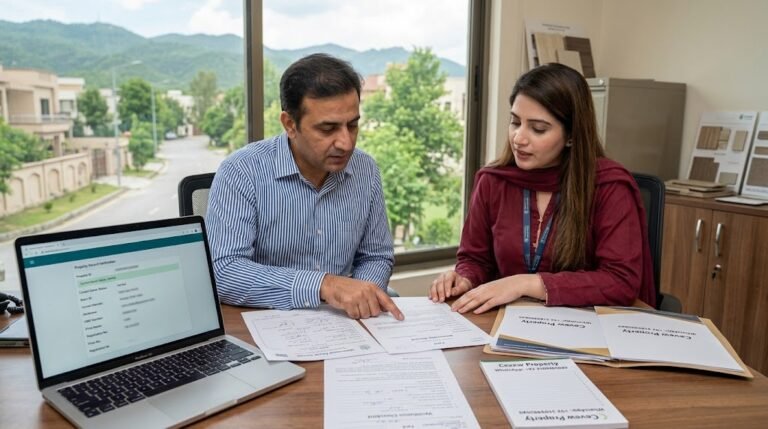
Document verification is the single most important step before buying a plot. Unlike a house, where you can at least see the physical structure, a plot's value is entirely tied to its documentation. A piece of land without clean documents is essentially worthless — no matter how good the location looks.
Key Documents for Plot Verification
- Allotment letter or transfer letter — The original document issued by the authority or society that allocated the plot to the current owner.
- Registry or sale deed — The registered document that proves legal ownership transfer. In CDA sectors, the registry may be through CDA; in revenue land outside CDA, it goes through the sub-registrar.
- Fard Malkiat (ownership record) — For plots outside CDA sectors, particularly in peri-urban Rawalpindi or revenue land, the Fard from the Patwari or revenue department is the key ownership record.
- Mutation (Intiqal) — The revenue record confirming that ownership has been transferred in government records after a sale.
- Society NOC or clearance certificate — For plots in private societies, the society's transfer office must confirm the plot is clear to transfer.
- CDA approval or No Objection Certificate — For societies, a CDA-approved NOC indicates the society itself is recognised by the relevant development authority.
- Latest utility bills or holding tax receipts — These show the plot is in regular standing with the relevant authority or society.
- Seller's CNIC and verification — Confirm the person selling is the actual owner or a legally authorised representative.
Never accept photocopies as proof of ownership. Photocopies can be forged, outdated, or altered. Always verify the original documents directly with the issuing authority — the CDA office, the housing society's transfer department, or the revenue department. This is not optional.
For plots in societies like Bahria Town, DHA, or PWD, the society's internal record is the ultimate source of truth. A seller's documents may look genuine, but if the society's transfer office says the plot has unpaid dues, a pending transfer dispute, or a name mismatch, do not proceed. Visit the society office yourself. This is the single most effective way to avoid plot scams.
What Is Zoning and Why Does It Matter for Plots?
Zoning is the legal designation that determines how a plot can be used. A plot marked as residential cannot legally be used for a commercial shop or office. A plot marked as agricultural may not be approved for housing construction. Buying a plot without understanding its zoning can leave you with land you cannot use the way you planned.
Common Zoning Categories in Islamabad and Rawalpindi
| Zoning Type | What It Means | What You Can Build |
|---|---|---|
| Residential | Approved for housing construction only. | Houses, residential apartments (depending on specific regulations). |
| Commercial | Approved for business use. | Shops, offices, commercial buildings, mixed-use (where permitted). |
| Mixed-Use | Approved for a combination of residential and commercial use. | Ground floor commercial with residential units above, depending on area rules. |
| Agricultural | Designated for farming or rural use. May have restrictions on residential construction. | Generally not approved for housing unless converted through the proper authority. |
| Industrial | Designated for factories, warehouses, or manufacturing. | Industrial structures only. |
← Scroll horizontally to view the full table →
Zoning regulations can change. A plot that was originally residential may have been re-designated as commercial or vice versa. Always confirm the current zoning status with the CDA or the relevant development authority before finalising a purchase. Do not rely on the seller's description.
Also understand ground coverage rules, floor area ratio (FAR), and setback requirements — these dictate how much of the plot you can actually build on and how far your structure must be from the boundary walls. A large plot does not necessarily mean you can build a large house if setback rules are restrictive.
What Should You Check During Physical Inspection of a Plot?
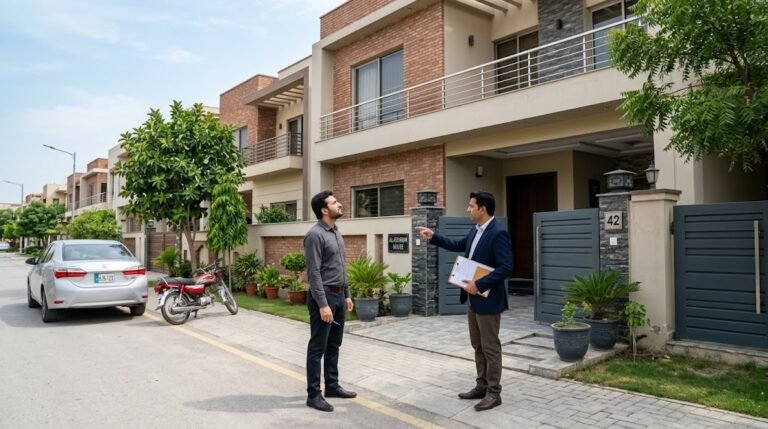
Photographs can be misleading. A plot that looks flat and ready for construction in pictures may have hidden problems when you visit in person. Physical inspection is not optional — no matter how convincing the listing or the agent is.
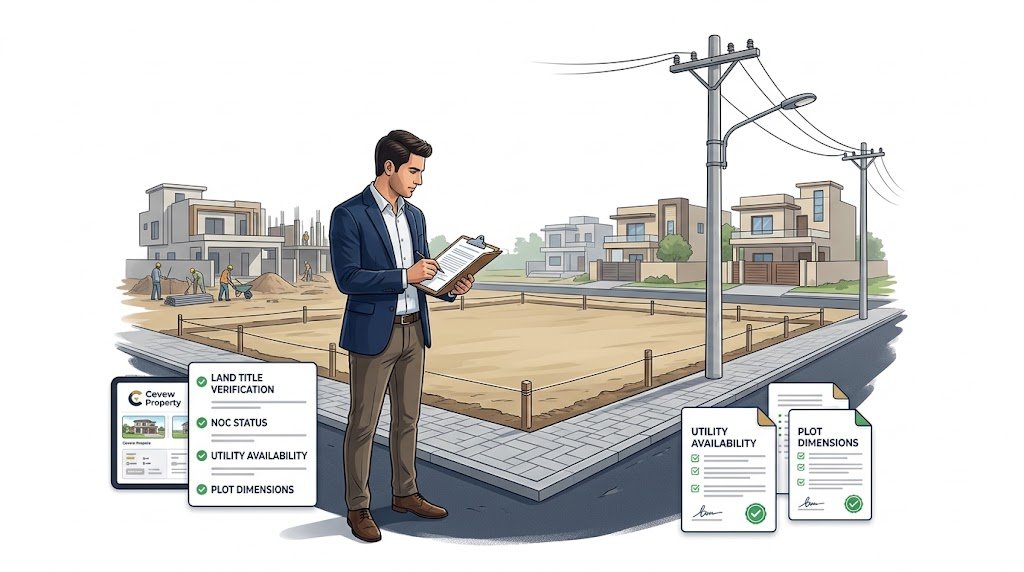 Physical inspection of the plot's boundaries, level, and surrounding environment is essential before signing any agreement.
Plot Inspection Checklist
- Boundary walls and markers — Physically walk the plot's perimeter. Confirm the marked boundaries match the dimensions stated in documents.
- Plot level — Is the plot level with the road or significantly higher/lower? Significant level differences can add major grading and retaining wall costs.
- Soil condition — Look for waterlogging, excessive vegetation, or soft ground. Poor soil may require additional foundation work.
- Flooding risk — Check whether water pools anywhere on the plot or nearby. Ask neighbours if the area floods during monsoon.
- Encroachments — Look for any signs that a neighbour has built structures, stored materials, or planted crops on the plot boundaries.
- Access road — Is the plot accessible by car? What is the road width? Is the road paved or unpaved?
- Plot shape — A rectangular or square plot is easier to design for than an irregular or triangular plot.
- Corner vs inner plot — Corner plots often have better access and ventilation but may have higher costs. Inner plots may offer more privacy.
- Facing direction — In Pakistan, east-west facing is often preferred for sunlight and ventilation. Check how neighbouring structures affect light and airflow.
- Surrounding environment — Walk around the block. Check for neighbouring construction, commercial activity, noise, and any nearby sources of pollution.
The Hidden Cost of a Low-Lying Plot
A buyer in a developing society outside Islamabad found a plot at an attractive price. The photographs showed flat, open land. But during a physical visit after rain, the buyer discovered the plot was in a low-lying area where water pooled for days. Building on that plot would have required significant earth filling and retaining walls — adding several lakh rupees to the construction cost. The buyer walked away and found a better plot on higher ground.
How Do You Confirm Utility Availability on a Plot?
A plot without access to basic utilities is not ready for construction. Electricity, water, gas, and drainage are not optional — they are essential for any building project. Some societies advertise plots with "all utilities available," but the reality on the ground may be different.
Utilities to Check Before Buying
- Electricity — Is there an electrical grid connection nearby? Is there a transformer in the area? What is the distance from the nearest power pole? Has the society or authority allocated a connection point for the plot?
- Water supply — Is there a municipal or society water supply network? If not, what is the water table depth for a boring? Is the water quality acceptable? Water scarcity is a growing concern in many areas around Islamabad and Rawalpindi.
- Gas connection — Gas connections in many societies are not automatically available. Check if the society has a gas pipeline network and whether new connections are being provided.
- Sewerage and drainage — Is there an underground sewerage system? If not, is a septic tank or soakage pit feasible? Poor drainage can cause long-term problems.
- Internet and cable — While not as critical as water and power, confirm that broadband internet providers service the area. This matters if you plan to work from home or rent the property.
Do not accept verbal assurances that "utilities will be connected soon." Confirm current status in writing with the society's office or the relevant utility provider. If a society says gas is "in process," ask for a timeline and verify whether any actual infrastructure work has been completed.
What Society or Authority Clearances Are Required Before Buying a Plot?
In Pakistan, plots fall under different administrative frameworks depending on their location. Understanding which framework applies to your plot is essential for verification.
The Three Main Categories
| Category | Examples | Verification Authority |
|---|---|---|
| CDA Sectors | G-13, G-14, G-15, I-14, D-12 | Capital Development Authority (CDA) |
| Private Housing Societies | Bahria Town, DHA, Gulberg Residencia, PWD, Soan Garden | The society's own transfer office, plus the relevant development authority (CDA, RDA, or Punjab authorities) |
| Revenue Land | Certain areas of Rawalpindi, peri-urban Islamabad | Sub-registrar office, revenue department (Patwari/Tapedar), and local development authority |
← Scroll horizontally to view the full table →
For plots in housing societies, the society's internal clearance is critical. Before finalising any payment, visit the society's transfer office and confirm:
- Is the plot in the seller's name according to the society's records?
- Are there any unpaid dues, transfer fees, or development charges?
- Is there any dispute, litigation, or legal hold on the plot?
- Is the plot's file complete and in order?
- Has the society approved the plot for transfer?
In societies like DHA and Bahria Town, the transfer office is the single most reliable source for plot status. Do not skip this visit. A plot that is not cleared for transfer by the society cannot be legally transferred to your name, regardless of what documents the seller shows you.
What Hidden Costs Come With Buying a Plot?
Just like buying a house, the asking price of a plot is not the total cost. Several additional expenses can add 5% to 10% or more to your total outlay. Many first-time plot buyers discover these costs too late.
Common Additional Costs for Plot Purchases
- Transfer fees — Charged by the CDA, society, or revenue department for transferring ownership records.
- Stamp duty — A government tax applied to the registered sale deed. The rate varies based on the declared property value and classification.
- Capital Value Tax (CVT) — Applicable in certain Islamabad areas, particularly CDA sectors.
- Society development charges — Many societies charge an annual development fee. If the seller has unpaid dues, these may fall on you before transfer.
- Agent commission — Typically 1% to 2% of the property value, though negotiable.
- Legal and documentation fees — Professional fees for verifying documents and handling the transfer process.
- Plot boundary wall or fencing — If the plot does not have boundary walls, you may need to build them to protect your investment.
- Land levelling and soil testing — If the plot is uneven or requires soil stabilisation.
- Utility connection fees — Electricity, gas, and water connection charges may apply separately.
Always add 5% to 10% of the plot price to your total budget for transaction costs. This is a conservative estimate. Some plots in developing societies may require additional development charges or utility connection fees that become apparent only during the transfer process.
Common Mistakes Plot Buyers Make
Plot scams and buyer mistakes are unfortunately common in Pakistan. Here are the most frequent errors we see — and how to avoid them.
The buyers who avoid plot scams are not the ones who know everything. They are the ones who refuse to skip verification steps — even when someone is pushing them to move fast.
Mistake #1: Buying Based on a "Future Development" Promise
"This society will have a commercial hub next year." "The road will be expanded soon." "Electricity will be connected in six months." Future development promises are not guarantees. Buy based on what exists today, not what is promised for tomorrow. If a society has no electricity, no water, and no proper road access today, assume it will stay that way unless you independently verify otherwise.
Mistake #2: Not Checking the Society's NOC Status
Many housing societies around Islamabad and Rawalpindi operate without a valid NOC from the relevant development authority. Some are outright illegal. Before buying a plot in any society, confirm the society's NOC status directly with the CDA, RDA, or the relevant authority. Do not rely on the society's own marketing material.
Mistake #3: Paying a Token Amount Before Verification
Agents and sellers may push you to pay a "token" or "booking amount" to hold the plot. Only do this after you have verified the documents and are satisfied with the property. Paying a token before verification makes it much harder to recover your money if the deal falls through.
Mistake #4: Skipping the Physical Visit
Do not buy a plot based on photographs, WhatsApp videos, or a video call. Visit the plot yourself. Walk the boundaries. Talk to neighbours. Check the road access. Look at the soil and drainage. If you are overseas, send someone you trust — a family member or a professional property verifier — to inspect the plot in person.
Mistake #5: Not Checking for Encroachments
In some areas, neighbouring property owners encroach on unbuilt plots — building a wall a few feet inside the plot, storing materials, or even planting crops. If you do not check and document the current boundaries, you may end up with less land than you paid for.
Mistake #6: Ignoring the Plot's Shape and Orientation
An irregularly shaped plot may be cheaper per square foot, but it can cost you more in design and construction. A triangular or trapezoid plot is harder to build on efficiently. A narrow plot may limit your house design. Consider how the shape affects usability before buying.
Mistake #7: Not Verifying the Seller's Identity
Confirm the seller's identity through their original CNIC. If someone is selling on behalf of the owner, ask for a valid, registered power of attorney. Do not accept a photocopy of a power of attorney — it can be forged or revoked. Verify it independently.
The Step-by-Step Plot Buying Process
Here is a clear, practical sequence for buying a plot safely. Follow these steps in order, and you will avoid the most common pitfalls.
-
01
Define Your Purpose
Are you buying to build a house, hold for investment, or for commercial use? Your purpose determines the type of plot, location, and zoning you need.
-
02
Set Your Total Budget
Include the 5–10% transaction cost buffer. Know your ceiling before you start looking.
-
03
Shortlist Locations
Based on your purpose, budget, and daily access. Visit areas at different times of day to understand traffic, noise, and environment.
-
04
Browse Available Plots
Use Cevew Property to compare plots across Islamabad and Rawalpindi. Filter by society, size, and price.
-
05
Physically Inspect Each Shortlisted Plot
Use the checklist above. Walk the boundaries. Check access, level, and surrounding environment.
-
06
Request All Documents
Ask for the allotment letter, transfer letter, registry, mutation, society NOC, utility bills, and seller CNIC.
-
07
Verify Independently
Visit the CDA office, society transfer office, or revenue department. Confirm ownership, dues, disputes, and zoning status.
-
08
Negotiate the Price
Understand the market value through comparable plots. Make a reasonable counter-offer based on your research.
-
09
Agree on Payment Terms
Standard practice is a token amount first, then balance at transfer. Understand the refund terms if the deal fails.
-
10
Complete the Legal Transfer
Execute the sale deed, apply for mutation or society transfer, and pay all applicable fees and taxes.
Plot vs House vs Apartment: Which Suits You?
If you are deciding between buying a plot, a house, or an apartment, here is a practical comparison to help you think through the trade-offs.
| Factor | Plot | House | Apartment |
|---|---|---|---|
| Initial Cost | Generally lower than a house | Highest among the three | Most affordable entry point |
| Construction Required? | Yes — you build yourself | No — ready to move in | No — ready to move in |
| Time to Use | 1–3+ years (construction period) | Immediate | Immediate |
| Control Over Design | Full control | Limited — you adapt to existing design | None — fixed layout |
| Maintenance Responsibility | None until built | Full responsibility | Shared through building maintenance fees |
| Rental Income | None until built | Immediate rental potential | Immediate rental potential |
| Appreciation Potential | Variable — depends on area and development | Generally stable | Generally slower appreciation |
| Best For | Buyers who want custom construction, investors with patience | Families ready to settle immediately | First-time buyers, small families, investors seeking rental yield |
← Scroll horizontally to view the full table →
If you are considering a full house instead of a plot, our house buying checklist for Islamabad and Rawalpindi covers the key checks for ready-built properties. If you are specifically looking in Rawalpindi, see our guide on buying a house in Rawalpindi.
Is Buying a Plot a Good Investment?
Plots have historically been seen as a safe investment in Pakistan. But "safe" does not mean "guaranteed profit." Plot prices can stagnate, decline, or appreciate unpredictably depending on the location, development, and broader market conditions.
If you are buying a plot to build a house on later, the investment question is secondary. Focus on whether the plot is in the right location for your future home and whether you can build on it when the time comes.
If you are buying with an investment mindset, evaluate these factors carefully:
- Is the society or area genuinely developing, or is development stalled?
- Is there actual demand for plots in this area, or is the market oversupplied?
- What is the holding cost — annual society charges, development fees, and taxes?
- How liquid is the market? Can you realistically sell the plot if you need cash?
- What is the rental potential if you build on the plot later?
✔ Pros of Buying a Plot
- Lower entry cost than a house
- Full design control when you build
- No immediate maintenance responsibility
- Potential for appreciation as area develops
✘ Cons to Consider
- No income until you build
- Carrying costs (society charges, taxes) continue
- Construction is expensive and time-consuming
- Risk of encroachment or boundary disputes
- Appreciation depends on development that may not happen
If you are comparing plots with ready-built properties in specific areas, browse our Islamabad area guides and Rawalpindi area guides to understand local market conditions.
Key Takeaways
- Verify ownership independently — Visit the CDA office, society transfer office, or revenue department yourself. Never rely on photocopies.
- Understand zoning — Confirm the plot is approved for your intended use before buying.
- Inspect the plot in person — Walk the boundaries, check the level, soil, drainage, and surrounding environment.
- Confirm utility availability — Electricity, water, gas, and drainage should be verified, not assumed.
- Check society NOC and clearance — The society's transfer office is the ultimate source of truth for plots in housing societies.
- Budget for hidden costs — Add 5–10% on top of the plot price for transfer fees, stamp duty, and society charges.
- Never rush — Pressure tactics are a red flag. A genuine plot will still be there next week.
- Get everything in writing — Verbal promises about utilities, development, or future value are not enforceable.
Frequently Asked Questions
How do I know if a housing society is legal?
Check whether the society has a valid No Objection Certificate (NOC) from the relevant development authority — the CDA for Islamabad, RDA for Rawalpindi, or the relevant Punjab authority. You can verify NOC status directly with the authority. Do not rely on the society's own marketing material or the seller's word.
Can I buy a plot on installments?
Many societies offer installment plans for plots. However, before committing to an installment plan, carefully read the terms. Check the total cost including interest or markup, what happens if you miss a payment, and whether the plot is actually allocated to you or merely "booked." Confirm the society's NOC status before entering any installment agreement.
What is the difference between a corner plot and an inner plot?
A corner plot has two sides facing roads, which often means better ventilation, more natural light, and easier access. Corner plots are sometimes priced higher. An inner plot is surrounded by other plots on more sides, which may offer more privacy but could have less airflow. The right choice depends on your priorities — visit both types before deciding.
What should I do if I suspect a plot listing is fake?
Stop all communication with the person who posted the listing. Do not send any money or share personal documents. Report the listing to the platform where you found it. Always verify ownership independently through the CDA, society transfer office, or revenue department before paying any amount.
Can an overseas Pakistani buy a plot in Islamabad or Rawalpindi?
Yes, overseas Pakistanis can buy plots in Pakistan. However, the verification process is more challenging from abroad. You should consider appointing a trusted family member, friend, or professional property verifier to physically inspect the plot and verify documents on your behalf. If using a power of attorney for the transaction, ensure it is properly registered and valid.
How long does it take to complete a plot purchase?
The timeline varies significantly. A plot in a well-managed society with clear documents may transfer in 2–4 weeks. CDA sector plots may take longer due to government procedures. Revenue land can take several months. Always plan for delays and do not rush the verification process to meet an artificial deadline.
Ready to Find the Right Plot?
Now that you understand what to check, the next step is to browse available plots in Islamabad and Rawalpindi. Compare options, visit shortlisted plots, and verify before you pay.
Browse Plots for Sale